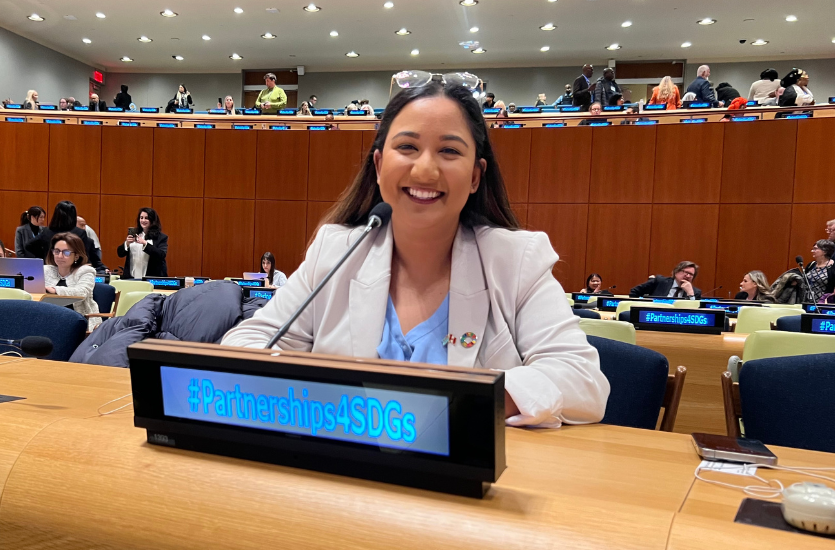
Rochelle Prasad Champions Co-curricular Innovation in Surrey
October 22, 2025From refugee family legacy to UN education advisor, educator Rochelle Prasad’s Award experience validates why Surrey District School Board’s co-curricular partnership with Award Canada matters for youth across British Columbia.
For Rochelle, education has always gone beyond textbooks and the classroom. For her, it’s about unlocking human potential across cultures, languages and circumstances. As a university professor, UN education policy advisor and board member of The Duke of Edinburgh’s International Award – Canada, she brings a unique perspective to one of Canada’s most innovative educational partnerships.
Rochelle grew up in the bustling, multicultural city, of Surrey BC. Her parents fled political upheaval from their native Fiji and came to Canada with limited formal education themselves, igniting a passion for learning in her at a young age. From childhood, Rochelle understood that learning happens everywhere and that every young person deserves pathways to discover their own potential.
Today, she’s helping the Surrey School District integrate the Award into its co-curricular programming as the district is one of Award Canada’s newest Education Operating Partner. A partnership that will make the Award framework accessible to students during school hours, rather than an after-school activity.
A Foundation Built on Family Legacy
Rochelle’s educational philosophy didn’t develop overnight and is deeply rooted in her family’s journey of resilience and displacement.
“My parents came from a legacy of indentured labor. They were forced to move multiple times, and education was always disrupted,” she reflects. “They didn’t finish high school, but they understood education was the pathway to opportunity. That’s the foundation of everything I do.”
Teaching at UC Berkeley and University Canada West Vancouver, she’s witnessed how traditional educational structures can either empower or exclude students from diverse backgrounds.
“When you understand that students come from vastly different starting points, different languages and different cultural contexts; you realize that a one-size-fits-all approach to education isn’t sufficient,” she explains. “Young people need multiple pathways to discover their strengths.”
The Award as Educational Innovation
Rochelle’s path that eventually led her to become an Award Canada champion was sparked by an experience that pushed her beyond her comfort zone. It all began when her parents got her involved in Girl Guides.
“My parents enrolled me, and I was both hesitant and nervous at first,” she laughs. “But Girl Guides provided me with lasting friendships and a sense of community. I stayed with it for nearly eight years.”
That initial step into the unknown evolved into a transformative experience through her Bronze, Silver and Gold Award pursuits. In pursuit of all three levels of the Award, she set personal goals across four key areas over a period of several months: volunteer service, skill building, physical activity and an adventurous journey. By pursuing and doggedly achieving her goals, Rochelle discovered a newfound sense of confidence and more.
Completing her Gold independently through the Virtual Award Centre while attending university taught her valuable lessons about accessibility and digital inclusion that continue to inform her current advocacy.
“The Award taught me that learning doesn’t stop at the classroom door,” she says. “As an educator now, I see how powerful that integration is. Especially for students who might not thrive in traditional academic settings.”
The Surrey Model: Co-curricular Innovation
The Surrey School District serves over 74,000 students across one of Canada’s most linguistically and culturally diverse communities. Award Canada’s Co-curricular Approach addresses these complexities by embedding it’s activities directly into the school experience.
“Surrey’s diversity is its greatest strength, but it’s also its greatest challenge from an educational perspective,” she explains. “When the Award becomes part of the school day, it removes barriers. Students don’t need to choose between family obligations, part-time jobs and personal development. They can balance and integrate all of those things into their daily lives.”
Early results from pilot programs are encouraging. Teachers report increased student engagement across diverse demographics, while students express greater connection to their learning and future goals.
“We’re not just adding another program, we’re rethinking how schools can recognize and develop the full range of student capabilities,” Rochelle notes. “A student who struggles academically might discover leadership through community service. Someone dealing with language barriers might build confidence through skill development. I can attest to the impact of these experiences first-hand.”
Global Perspective, Local Impact
Rochelle’s international education experience adds further validation to Surrey’s willingness to embrace a broader approach to local education. As a UN education policy advisor, she’s seen how different systems worldwide struggle with similar challenges.
“I’ve worked with education systems across multiple continents, and the challenge is universal. How do you serve diverse student populations while maintaining quality and equity?” she reflects. “What excites me about the Surrey model is that it’s addressing these issues proactively and systematically.”
Her work building schools internationally through her Spark Foundation has reinforced her belief that education must be both globally minded and locally responsive; which is exactly what the Award framework provides through its international network and local implementation.
The Investment Imperative
For Rochelle, the case for supporting Award Canada’s continuing expansion and reach is deeply personal. She frames it as investment, not charity. “Every dollar invested in youth development through experiential learning pays dividends in creating stronger communities and more capable leaders,” she states.
She’s particularly passionate about funding programs like the Surrey model, where donor investment helps inspire countless students from all backgrounds and abilities to develop their full potential across communities throughout Canada.
“When you support frameworks like this, you’re not just helping one student; you’re validating an approach that can transform entire educational systems,” she explains. “These young people in Surrey are already contributing to their communities, already solving problems and already leading. Our job is to give them tools to amplify that impact.”
From a cautious Girl Guide beginner, to UN advisor and educational innovator, Rochelle exemplifies the Award’s transformative power.
Learn more about the Co-curricular Approach“The Award showed me learning happens everywhere, for everyone. Now we’re proving that works at scale. That’s an investment into our collective future and it’s well worthwhile.”
Share this...

